Monday, June 2, 2014

Cookbook: Cooking From The Pantry

From the Capital Area Health Alliance...
 
We are pleased to announce the roll out of Cooking from the Pantry.  Many families find it challenging to create healthy meals on a tight budget. This cookbook is intended to help people make the most out of foods that can be found at a local food pantry.  These recipes and food tips have been compiled with help from the Greater Pittsburgh Community Food Bank, Mid-Michigan District Health Department, and MSU Extension.  The Cooking from the Pantry Cookbook was produced by the Capital Area Health Alliance through the Michigan Health and Wellness 4 x 4 Grant as well as the generous printing donation of ASAP.
 
The cookbook is available on the Alliance website at www.choosinghealth-caha.org/pantry_cookbook.php.  Hard copies are also available.  Please contact us at 517-347-3377 if you are interested in distributing some cookbooks to your constituents.

Wednesday, May 28, 2014

Growing School Gardens

edWeb.net - Growing School Gardens
Free Webinars
Meet the Presenters

Danielle Fleury, Farm to School Lead in the USDA Food and Nutrition Service's Northeast Regional Office  
Emily Jackson, Founder and current Director of the Growing Minds Farm to School program of the Appalachian Sustainable Agriculture Project  
Brad Pillen, CitySprouts Garden Educator

Meg Giuliano, CitySprouts Garden Educator 
Thank you to our co-hosts

The Edible Schoolyard Project 
Life Lab 
National Farm to School Network
Summertime in the School Garden:
Exploring Opportunities to Support and Share Your School Garden
Wednesday, May 28th at 4pm ET
REGISTER HERE
Presenters: Danielle Fleury with Emily Jackson
Summertime presents both unique challenges and important opportunities when it comes to school gardens. Who takes care of the garden when school is out? How can the school garden be connected to summer learning and healthy food access opportunities?
In our community's next webinar, Mary Stein, Associate Director of the National Farm to School Network, hosts two partners from the Appalachian Sustainable Agriculture Project and the USDA-FNS for a discussion of various aspects of school gardens in summer. You will hear examples ofhow school gardens across the country are connecting to important summer feeding program sites and other out-of-school educational opportunities.
Then, learn about how Cooperative Extension, Master Gardeners, YMCAs, universities, parent coalitions and more can connect your school garden to the community during the summer break. Join us on May 28th for ideas and steps to take to connect with community partners to make the most of your school garden during the summer months.
Healthy Food + Healthy Ecosystems = Healthy Neighborhoods
(A Summer Garden Program for Middle School Youth)
Monday, June 16th at 4pm ET
REGISTER HERE
Presenters: Brad Pillen and Meg Giuliano, CitySprouts Garden Educators 
Middle schoolers can get a lot out of the school garden experience, from growing food to learning about the science underlying the natural world. At CitySprouts summer youth program in Cambridge, MA, 100 young people ages 11-13 go through a month-long summer internship program at various schoolyard garden locations.
Middle school interns learn garden skills and how to care for their school garden - planting, weeding, watering and harvesting food for lunch. They go on field trips to hunger-relief organizations, grocery stores, and farms outside the city to get a bigger picture of their local food system. They also learn about the interdependent relationships that exist among parts of an ecosystem as they explore the compost, the garden soil and water catchment systems in the school garden.
In this webinar Brad Pillen and Meg Giuliano, two CitySprouts Garden Educators, will present about using school gardens in the summertime. They will share with us how CitySprouts connects and engages 6th-8th graders with STEM core ideas and food systems through their Out-of-School Time Service Learning Curriculum that connects to the new Next Generation-aligned standards for 6th grade ecosystems. Join Brad and Meg to learn more about summer garden programs for middle school youth.
Growing School Gardens
School gardens are a growing initiative to help children understand where their food comes from and how their food choices impact their bodies, the environment, and their communities at large.
A school garden can have an impact on the entire life and educational program of school and the surrounding community. Gardening activities can be incorporated into nearly every curriculum subject to enhance the appreciation of the natural world, and to provide hands-on learning activities for students.

As a member of the community, you'll receive...
  • Invitations to free webinars and live chats.
  • CE certificate for attending/viewing our webinars.
  • Access to all of the recorded webinars, presentations, resources, and online discussions.
This online learning community is a place for educators, gardeners, parents, and community volunteers to come together to share information and resources on how to start and maintain a school garden, and integrate it into the curriculum and the life of a school.
JOIN the Community

Friday, May 23, 2014

CFN May 2014 Meeting Agenda


Feel free to come to the meeting early and help with planting in the raised beds:)  
 
Community Food Network Meeting
Date and Time: Tues. May 27, 2014 at 3:30pm
Location:  H.O. Steele Education Center
North 66  between 57  & 44  (10260 S Sheridan Rd., Fenwick, MI  48834)


Committees

 
    • Gardens & Pantry Committee:
    • Needs still unmet?  

 
    • Other updates?  

 
    • Awareness & Resource Committee:  
    • Plant A Row Outreach Plan--This is ongoing
    • Sheridan Family Health Fair Thurs, June 26, 2014  2-5pm at the Sheridan Community Center.  Billie will have a table set up with United Way so will be on hand for CFN.  Anyone else interested in setting up table just for CFN stuff?  There is no cost.
 
    • Billie working on getting to all the food pantries with the farmer’s market materials.  Some places have been given the print outs.  This will be done by the end of next week.  Anyone like to help distribute?


    • Educational Committee:   
    • Outdoor Learning Lab soon to be set up at H.O. Steele Education center.


The next meeting will be the on June 24 at 3:30 pm at the H.O. Steele Education Center


Tuesday, May 13, 2014


Grant Opportunity

Department of Agriculture Logo USDA-AMS-LFPP-2014
 2014 Local Food Promotion Program Grants
 Department of Agriculture
 Agricultural Marketing Service


The Local Food Promotion Program is a component of the Farmers Marketing and Local Food Promotion Program (FMLFPP), authorized by the Farmer-to-Consumer Direct Marketing Act of 1946.  Under FMLFPP, two completive grant programs are available: the Farmers’ Market Promotion Program (FMPP) and the Local Food Promotion Program (LFPP). LFPP offers grant funds with a 25% match to support the development and expansion of local and regional food business enterprises to increase domestic consumption of, and access to, locally and regionally produced agricultural products, and to develop new market opportunities for farm and ranch operations serving local markets.  Two types of project applications are accepted under LFPP—planning grants and implementation grants. Applicants can apply for either but will receive only one type of grant in the same grant cycle. LFPP Planning Grants are used in the planning stages of establishing or expanding a local and regional food business enterprise. Activities can include but are not limited to market research, feasibility studies, and business planning. A minimum of $5,000 and a maximum of $25,000 will be awarded for any one proposal, and the grants must be completed within a 12 month period; extension will not exceed an additional 6 months. LFPP Implementation Grants are used to establish a new local and regional food business enterprise, or to improve or expand an existing local or regional food business enterprise. Activities can include but are not limited to training and technical assistance for the business enterprise and/or for producers working with the business enterprise; outreach and marketing to buyers and consumers; working capital; and non-construction infrastructure improvements to business enterprise facilities or information technology systems. A minimum of $25,000 and a maximum of $100,000 will be awarded for any one proposal, and the grants must be completed within a 24 month grant period; extension will not exceed an additional 6 months.

Who is eligible to apply?
Agricultural Business
Agricultural Cooperative
Producer Network
Producer Associations
Community Supported Agriculture (CSA) Network
CSA Associations
Local Government
Nonprofit Corporation
Public Benefit Corporation
Economic Development Corporation
Regional Famers Market Authority
Tribal Government 

 
More information and how to apply:


Thursday, May 8, 2014

Building Smart Soils

Build smart soils using mulch, composted organic matter and reducing tillage

Learn steps for smart soil building right in your backyard or vegetable garden.

Photo credit: Normanack, Flikr.com
Home gardeners can build smart soilsyear round, but with the start of gardening season, now is a perfect time to plan and implement techniques that will create healthy soils for your vegetable garden. Sustainable practices include use of organic mulches, composted material and reducing tillage. Home gardeners can also look for more local sources of mulch and composted material.

Organic mulches

Organic mulches can be grass clippings, compost, mulched leaves, wood chips, shredded bark, marsh hay or straw. All organic types of mulch break down over time and add nutrients back to the soil. Be cautious with the use of chips or bark; you may want to use it between your rows or areas of vegetable plantings rather than against the base of plants. Use chips or bark that isn’t freshly chipped and place it on top of soil rather than mixing it into the soil.
Where can gardeners find mulches? Look first within your own backyard. Michigan State University Extension does advocate that you return your glass clippings and mulched leaves back to your lawn, but if you have an excess of leaves, you can alternate mulching leaves on your lawn with bagging them up. Use the bagged ones as mulch on your vegetable garden. Additional local mulch sources may include a city’s yard waste collection site, a lumber mill for wood chips (make sure they have aged and dried for a season), or a feed mill or farmer for straw or marsh hay.
Be sure to apply 3 inches of mulch around vegetables and flowers. Mulch will not only add to the soil’s health as it breaks down, but it will also conserve water by reducing evaporation of water from the soil surface. Use of mulch provides a more even soil moisture for plants, thus decreasing stress. It also serves as a barrier against weed seeds, therefore you will have less weeding.

Compost material

Creating composted material or organic matter is another sustainable and smart gardening practice. Make use of a backyard compost system in order to create your own organic matter. Something as simple as three 4x4 untreated wooden pallets fastened together will work. In here, you can place all of your vegetable scraps from the kitchen and excess yard waste.
It’s important to add the right ratio of carbon sources to nitrogen sources within your compost pile. The proper ratio aids in the decomposition or breakdown of this organic material by microbes which need to be present for your pile to work. Using a mixture of brown sources (carbon) such as fallen leaves or wood chips to green sources (nitrogen) such as leafy green plants will help your pile have the right ratio.
It’s also important to allow the pile to heat up internally to a temperature of 130-160 degrees. Be sure that the pile does not dry out during this time. Be sure to provide air to your pile by mixing it. Again, you can also seek out local sources of compost at city compost sites or perhaps a local farm may offer composted material for purchase. Some things to consider, especially for local pickup sources, is whether or not the material has been prepared properly to prevent weed seeds. Also, whether or not pesticides were applied would be difficult to determine with a city compost site collecting from numerous lawns.
Collecting compost
Collecting compost. Photo credit: Mcav0y, Flikr.com

Reducing tillage

Reducing the amount of tillage will also lead to healthier soil. Too much tillage breaks down the natural structure of the soil. Tillage also releases carbon into the atmosphere, thus upsetting the required carbon to nitrogen ratio that microbes within the soil need in order to live and continue the decomposition process that the soil relies upon. Use of mulch and addition of composted material with minimal soil disruption will help build you a healthier soil. It probably won’t all happen this year, but you can begin the process.
Other techniques for minimal tillage include use of root crops, such as longer radishes or turnips, to help break up soil particles and create air and water spaces. Check out the new Smart Soils video with MSUentomologist George Bird who highlights these important steps to a smart soil and shows us the living components within a healthy soil.
For more information on a wide variety of Smart Gardening topics, visit the Gardening in Michigan website at www.migarden.msu.edu or contact MSU’s toll-free garden hotline at 1-888-678-3464.

Tuesday, May 6, 2014

Garden Space Available in Ionia

North of Ionia, near the radio station, there is garden space available for anyone who would like to use it.  Believed to be enough space for about 2 families to have a nice garden, water is also available.  The area was not used in 2013 but was used in 2012 so there will need to be some work done.  A tiller may possibly be available to use.  If you are interested and want more info, please contact Billie Patterson @ 616-794-9840.

Grants for School Gardens

K-12 School Gardens Funded 
Annie's Grants for Gardens
  
(http://www.annies.com/giving-back/school-gardens/grants-for-gardens/)

Annie's Grants for Gardens are provided to K-12 school gardens nationwide that connect children directly to real food. 
Two types of grants are provided. “Getting Started: Funds for Your New Program” offers grants of $500 to start brand-new school garden programs. “Digging Deeper: Funds for Your Existing Program” offers grants of $1,500 to enhance current school garden programs. Online applications must be submitted by June 2, 2014. Visit the company’s website to review the grant guidelines.


Friday, April 25, 2014

April Meeting CANCELLED!


Community Food Network Meeting scheduled for Tuesday, April 29, 2014 at 3:30pm has been CANCELLED.  


The next meeting will be:
 
Date and Time: March 25th, 2014 at 3:30pm
Location:  H.O. Steele Education Center
North 66  between 57  & 44  (10260 S Sheridan Rd., Fenwick, MI  48834)

Growing Strawberries!

How to Grow Strawberries in 10 Easy Steps
We are looking forward to starting some strawberry plants in the IM Kids Garden at H.O. Steele Education Center this year!  While doing research on this project, I stumbled across this really great website:  http://strawberryplants.org/  Be sure to check it out if you want to learn about strawberries!
Walk through these 10 steps, and it is virtually guaranteed that you’ll end up experiencing strawberry success:
1. Pick Which Type of Strawberry
There are three main types of strawberries: June-bearing, everbearing, and day-neutral.  Some people consider everbearing and day-neutral varieties to be the same thing, but they are actually different.  For a full discussion of each, see the Strawberry Varieties reference page.  In short, June-bearers have the largest fruit but only produce one big crop over a week or two.  Everbearers produce a larger early crop, smaller late crop, and a few berries in between, while day-neutrals produce throughout the growing season.  Everbearers and day-neutrals typically produce less and smaller berries overall than do the June-bearing varieties.
Considering these characteristics will determine which type is right for you.  If you want fresh berries throughout the year and don’t mind picking smaller and fewer, go with a day-neutral or everbearing variety.  If you want sheer quantity of berries, go with a June-bearer (what most people do).
Considerations on how you plan to use your strawberries also come into play when determining which type to buy and plant.  If you want to can or preserve your harvest, it is easiest to accomplish your goals with the larger size and quantity that come from June-bearing strawberries.
2. Pick the Right Variety
Not all strawberry varieties are created equally.  Strawberries are temperate by nature and can be finicky as to what makes them happy.  So, thanks to decades of dedicated breeding programs, scores of specialized strawberry varieties have been developed and released.  The most generally-adapted cultivars have become quite popular, but the popular varieties might not be the best choice for your location.  To help you find which variety is suitable for your state/location, I have gathered the recommendations by state Extensions and compiled them in one place.  To be sure you get an appropriate variety, check the recommended varieties for your area and choose one suitable to your locale.
You may also want to extend your growing season by choosing early-, mid-, and late-season varieties.  Doing so can extend your harvesting period as follows:
how to grow strawberries

By choosing multiple strawberry varieties with different production peaks, it is possible to extend the strawberry season to about a full month for the June-bearing plants, which tend to produce the biggest strawberries.
And, if you have garden space, you might want to consider growing some novelty or specialty strawberries.  Pineberries are the latest to spark wide-spread interest due to their white color, red seeds, and pineapple taste.  Also, this season is also expected to be the first prominent one for the brand-new Purple Strawberries (not-GMO).  And, absolutely no strawberry variety tops the classic and diminutive Alpine varieties for sheer taste and aroma for specialty and gourmet recipes.  The possibilities are almost endless!
3. Pick the Right Quantity to Order
Part of learning how to grow strawberries is picking the right amount of plants to begin your patch.  Thinking through your goals and planned uses for your berries will guide your ordering/buying.  If you buy too many, you might be overwhelmed.  If you buy too few, you might be frustrated with the lack of berries when you need them.   Before you order, be sure to think about and study up on what you are going to need.  These resources should give you the information you need: How Many Strawberry Plants per PersonHow Many Strawberries do Strawberry Plants Produce, and Strawberries per Day.
4. Buy the Strawberry Plants
Once you have settled on the type, variety, and quantity of strawberry plants, all that is left is to get the best possible deal on plants.  We’ve made it as easy for you as it can possibly be.  Go to the Buy Strawberry Plants page, click your chosen variety in the alphabetical table at the top.  That will take you to a list of every online nursery that offers your variety for sale.  Check the prices on each of your desired varieties and then order whichever offers you the best deal!  If you’d rather buy from a bricks-and-mortar establishment or nursery, see our directory of local Strawberry Nurseries.
5. Plant the Strawberry Plants
planting strawberries
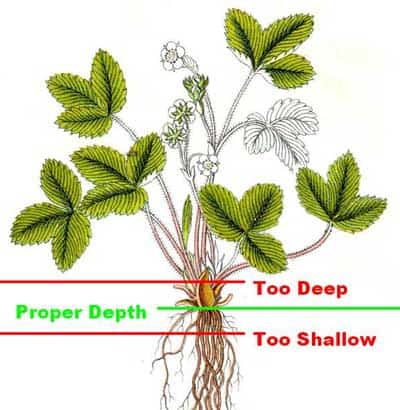
Whether you buy them at the store or order them online, as soon as you get the strawberry plants to your garden, get them in the ground as quickly as possible.  Strawberry plants have a thick section of tissue called the “crown” between the stems and roots.  Your plants should be planted so that the crown is even with the soil.  Plant them too high, and the roots dry out.  Plant them too low or completely bury the crown under the soil, and your plants will be much more likely to suffer injury or disease.
The time of year is a consideration in planting strawberries as well.  Most gardeners plant strawberries when the weather is warming up in the spring.  That is fine, of course, but planting in the fall has its benefits.  I won’t go into those here, however, as this is mainly a guide for spring planting!
There are also multiple different ways you can arrange your strawberry patch.  Your growing system tends to determine how you plant.  For most gardeners, the easiest and most productive method is the matted row system.  You simply plant, let ‘em go wild, and harvest abundantly!  Ok, that may be a bit oversimplified, but not by too much.  For the other systems, see the Growing Strawberries reference page, which is linked immediately below in the next section about on-going care.
6. How to Grow Strawberries: On-going Care
To maximize the vitality of your strawberry plants, and to help them put as much effort as possible into producing strawberries for you to enjoy, some on-going care is required.  To maximize the future yields of strawberries, it is best to snip the strawberry flowers during the first planting season.  This allows the roots to develop and will help your plants ratchet up future production.  Additionally, be sure to water them appropriately, fertilize with either conventional or organic fertilizers, and protect your plants.  For the details of how to do this effectively, be sure to review the appropriate sections on the Growing Strawberries reference page.
7. Harvest Your Strawberries
Strawberries are one of the first plants to fruit in the spring.  The strawberry harvest is heralded as a good omen in many locations, and numerous Strawberry Festivalscelebrate the little red berries all around the country.  Picking your home-grown strawberries is rewarding and should be celebrated as well!  The temptation, however, is to pluck the fruits before they are ripe and to rip the fruit off at the calyx.  Both can be problematic.  Review the ripeness spectrum in the picture, and try to refrain from picking white-tipped or pale red fruits.  Stick to harvesting berries that look like the ones at the right, and you’ll enjoy sweeter, bioflavonoid-rich, high-Vitamin C strawberries.
grow strawberries

When picking your strawberries, be sure to exercise patience and pick the fruits that look like the ones at the right end of the spectrum. Picking prematurely halts the development of the natural sugars, nutrients, and vitamins and will result in harder, tart or sour berries.
When it comes to actually separating the fruit from the plant, try not to grab the berry and pull.  Ripe fruits will be damaged by this technique.  Instead, use the nails of your thumb and forefinger to “snip” the stem holding the fruit.  The freed berry will roll gently into your palm without damage.  To see this illustrated, see the Strawberry Picking page.
Once harvested, shelf life is limited.  If you plan on using your haul fresh, be sure you know How to Store Strawberries.   If you plan on saving them for later use, move on to the next step!
8. Preserve or Use Your Strawberries
Like most garden plants, strawberries produce in season.  While the seasons vary, it is difficult to keep a plant producing all year (and, it is hard on the plants!).  So, taking the harvest and preserving them for future use makes a lot of sense.  Whether they are jammed, jellied, dried, or saved in some other form, most people love Strawberry Preserves.  If you don’t have a traditional family recipe for strawberry preserves, feel free to use any of those!  Or, if you prefer more Fragaria delightfulness at a lower temperature, try one of the 8 main methods of Freezing Strawberries to preserve your harvest.  And, of course, be sure to use as many as you can in delicious Strawberry Recipes!
9. How to Grow Strawberries: Perennial!
One of the most fantastic aspects of the humble strawberry is the fact that it is perennial.  Plus, most varieties propagate like crazy, thus multiplying an initial strawberry plant purchase into more runner plants than you know what to do with!  To make sure your strawberries do well year to year, your beds need to be renovated after they are finished producing.  The how-to is here: Strawberry Renovation.  Additionally, to make the most of your plants’ vitality, you can use a simple system to effectively Transplant Strawberries (there are actually several ways to Propagate Strawberry Plants).
10. Protect Your Plants

Strawberry plants are perennial, but can and do suffer cold injury in the winter if the temperatures drop too low, or if a warm spell is followed by another cold snap.  The final step in learning how to grow strawberries is to learn how to keep them alive year-to-year.  To adequately protect your plants, there are two main ways to keep them in a more hospitable environment: overwinter them in the ground or move them into a more protected place (if they are in containers).
To overwinter them in the ground, it is usually best to protect them with a mulch of some sort.  This most commonly done with straw, but can be done with other materials like recycled newspaper as well.  If you plan on leaving them in containers, see this guide onoverwintering strawberries for how to do it.
How to Grow Strawberries: Conclusion
If you’ve made it this far, you are probably already committed and excited about growing your own strawberries.  But, if you are still on the fence, let me give you 10 reasons to grow your own strawberries this year!  Good luck, happy gardening, and feel free to use the comments to ask any questions you might have!