How to Grow Strawberries in 10 Easy Steps
We are looking forward to starting some strawberry plants in the IM Kids Garden at H.O. Steele Education Center this year! While doing research on this project, I stumbled across this really great website: http://strawberryplants.org/ Be sure to check it out if you want to learn about strawberries!
Walk through these 10 steps, and it is virtually
guaranteed that you’ll end up experiencing strawberry success:
1. Pick Which Type of Strawberry
There are three main types of strawberries:
June-bearing, everbearing, and day-neutral. Some people consider
everbearing and day-neutral varieties to be the same thing, but they are
actually different. For a full discussion of each, see the Strawberry Varieties reference
page. In short, June-bearers have the largest fruit but only produce one
big crop over a week or two. Everbearers produce a larger early crop,
smaller late crop, and a few berries in between, while day-neutrals produce
throughout the growing season. Everbearers and day-neutrals typically
produce less and smaller berries overall than do the June-bearing varieties.
Considering these characteristics will determine
which type is right for you. If you want fresh berries throughout the
year and don’t mind picking smaller and fewer, go with a day-neutral or
everbearing variety. If you want sheer quantity of berries, go with a
June-bearer (what most people do).
Considerations on how you plan to use your
strawberries also come into play when determining which type to buy and
plant. If you want to can or preserve your harvest, it is easiest to
accomplish your goals with the larger size and quantity that come from June-bearing
strawberries.
2. Pick the Right Variety
Not all strawberry varieties are created
equally. Strawberries are temperate by nature and can be finicky as to
what makes them happy. So, thanks to decades of dedicated breeding
programs, scores of specialized strawberry varieties have been developed and
released. The most generally-adapted cultivars have become quite popular, but the popular varieties
might not be the best choice for your location. To help you find which
variety is suitable for your state/location, I have gathered the
recommendations by state Extensions and compiled them in one place. To be
sure you get an appropriate variety, check the recommended varieties for your area and
choose one suitable to your locale.
You may also want to extend your growing season
by choosing early-, mid-, and late-season varieties. Doing so can extend
your harvesting period as follows:

By choosing multiple strawberry varieties with
different production peaks, it is possible to extend the strawberry season to
about a full month for the June-bearing plants, which tend to produce the
biggest strawberries.
And, if you have garden space, you might want to
consider growing some novelty or specialty strawberries. Pineberries are the latest to spark
wide-spread interest due to their white color, red seeds, and pineapple
taste. Also, this season is also expected to be the first prominent one
for the brand-new Purple Strawberries (not-GMO). And, absolutely no
strawberry variety tops the classic and diminutive Alpine varieties for sheer taste and
aroma for specialty and gourmet recipes. The possibilities are almost
endless!
3. Pick the Right Quantity to Order
Part of learning how to grow strawberries is
picking the right amount of plants to begin your patch. Thinking through
your goals and planned uses for your berries will guide your
ordering/buying. If you buy too many, you might be overwhelmed. If
you buy too few, you might be frustrated with the lack of berries when you need
them. Before you order, be sure to think about and study up on what
you are going to need. These resources should give you the information
you need: How Many Strawberry Plants per Person, How Many Strawberries do Strawberry Plants Produce,
and Strawberries per Day.
4. Buy the Strawberry Plants
Once you have settled on the type, variety, and
quantity of strawberry plants, all that is left is to get the best possible
deal on plants. We’ve made it as easy for you as it can possibly
be. Go to the Buy Strawberry Plants page, click
your chosen variety in the alphabetical table at the top. That will take
you to a list of every online nursery that offers your variety for sale.
Check the prices on each of your desired varieties and then order whichever
offers you the best deal! If you’d rather buy from a bricks-and-mortar
establishment or nursery, see our directory of local Strawberry Nurseries.
5. Plant the Strawberry Plants
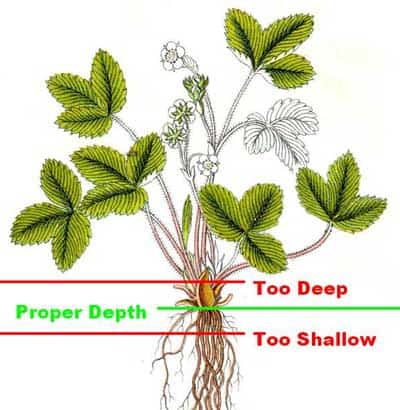
Whether you buy them at the store or
order them online, as soon as you get the strawberry plants to your garden, get
them in the ground as quickly as possible. Strawberry plants have a thick
section of tissue called the “crown” between the stems and roots. Your
plants should be planted so that the crown is even with the soil. Plant
them too high, and the roots dry out. Plant them too low or completely
bury the crown under the soil, and your plants will be much more likely to
suffer injury or disease.
The time of year is a consideration in planting
strawberries as well. Most gardeners plant strawberries when the weather
is warming up in the spring. That is fine, of course, but planting in the fall has its benefits.
I won’t go into those here, however, as this is mainly a guide for spring
planting!
There are also multiple different ways you can
arrange your strawberry patch. Your growing system tends to determine how
you plant. For most gardeners, the easiest and most productive method is
the matted row system. You simply plant,
let ‘em go wild, and harvest abundantly! Ok, that may be a bit
oversimplified, but not by too much. For the other systems, see the
Growing Strawberries reference page, which is linked immediately below in the
next section about on-going care.
6. How to Grow Strawberries: On-going Care
To maximize the vitality of your strawberry
plants, and to help them put as much effort as possible into producing
strawberries for you to enjoy, some on-going care is required. To
maximize the future yields of strawberries, it is best to snip the strawberry flowers during the first
planting season. This allows the roots to develop and will help your
plants ratchet up future production. Additionally, be sure to water them
appropriately, fertilize with either conventional or organic fertilizers, and
protect your plants. For the details of how to do this effectively, be
sure to review the appropriate sections on the Growing Strawberries reference page.
7. Harvest Your Strawberries
Strawberries are one of the first plants to
fruit in the spring. The strawberry harvest is heralded as a good omen in
many locations, and numerous Strawberry Festivalscelebrate the little
red berries all around the country. Picking your home-grown strawberries
is rewarding and should be celebrated as well! The temptation, however,
is to pluck the fruits before they are ripe and to rip the fruit off at the
calyx. Both can be problematic. Review the ripeness spectrum in the
picture, and try to refrain from picking white-tipped or pale red fruits.
Stick to harvesting berries that look like the ones at the right, and you’ll
enjoy sweeter, bioflavonoid-rich, high-Vitamin C strawberries.

When picking your strawberries, be sure to
exercise patience and pick the fruits that look like the ones at the right end
of the spectrum. Picking prematurely halts the development of the natural
sugars, nutrients, and vitamins and will result in harder, tart or sour
berries.
When it comes to actually separating the fruit
from the plant, try not to grab the berry and pull. Ripe fruits will be
damaged by this technique. Instead, use the nails of your thumb and
forefinger to “snip” the stem holding the fruit. The freed berry will
roll gently into your palm without damage. To see this illustrated, see
the Strawberry Picking page.
Once harvested, shelf life is limited. If
you plan on using your haul fresh, be sure you know How to Store Strawberries. If
you plan on saving them for later use, move on to the next step!
8. Preserve or Use Your Strawberries
Like most garden plants, strawberries produce in
season. While the seasons vary, it is difficult to keep a plant producing
all year (and, it is hard on the plants!). So, taking the harvest and
preserving them for future use makes a lot of sense. Whether they are
jammed, jellied, dried, or saved in some other form, most people love Strawberry Preserves. If you don’t
have a traditional family recipe for strawberry preserves, feel free to use any
of those! Or, if you prefer more Fragaria delightfulness
at a lower temperature, try one of the 8 main methods of Freezing Strawberries to preserve
your harvest. And, of course, be sure to use as many as you can in
delicious Strawberry Recipes!
9. How to Grow Strawberries: Perennial!
One of the most fantastic aspects of the humble
strawberry is the fact that it is perennial. Plus, most varieties
propagate like crazy, thus multiplying an initial strawberry plant purchase
into more runner plants than you know what to
do with! To make sure your strawberries do well year to year, your beds
need to be renovated after they are finished producing. The how-to is
here: Strawberry Renovation. Additionally,
to make the most of your plants’ vitality, you can use a simple system to
effectively Transplant Strawberries (there are
actually several ways to Propagate Strawberry Plants).
10. Protect Your Plants
Strawberry plants are perennial, but
can and do suffer cold injury in the winter if the
temperatures drop too low, or if a warm spell is followed by another cold
snap. The final step in learning how to grow strawberries is to learn how
to keep them alive year-to-year. To adequately protect your plants, there
are two main ways to keep them in a more hospitable environment: overwinter
them in the ground or move them into a more protected place (if they are in
containers).
To overwinter them in the ground, it is usually
best to protect them with a mulch of some sort. This most commonly done with straw, but can be done with
other materials like recycled newspaper as well. If
you plan on leaving them in containers, see this guide onoverwintering strawberries for how to
do it.
How to Grow Strawberries: Conclusion
If you’ve made it this far, you are probably
already committed and excited about growing your own strawberries. But,
if you are still on the fence, let me give you 10 reasons to grow your own strawberries this
year! Good luck, happy gardening, and feel free to use the comments to
ask any questions you might have!

No comments:
Post a Comment